
Why Most Hotel Blogs Fail (Even When They’re Active)

I once wrote a blog post about “ghost month” in Vietnam. It wasn’t about hotels, not about rooms, not even about booking. Just a cultural topic that travelers might search when they’re trying to understand the country.
At the time, it didn’t seem like a “high-value” keyword. Even my manager laughed at it.
But almost a year later, when I searched for “ghost month Vietnam” our website showed up near the top, even though it’s still relatively new. That’s when something clicked.
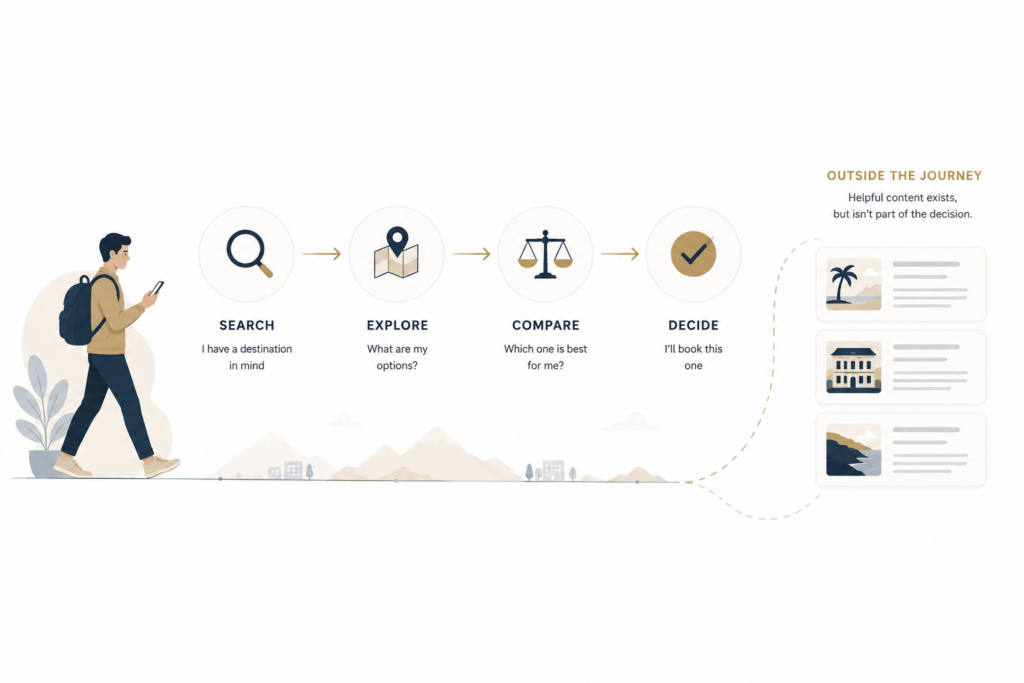
People searching for things like this are not booking yet, but they’re already entering the journey. They’re forming context, building understanding — this is how travelers start forming decisions before choosing a hotel, and slowly moving toward a decision. And if your hotel shows up at that stage — even once — you’ve already done something most hotels never do.
You’ve entered the conversation before it becomes a transaction.
Where The Journey Actually Begins
I’ve been looking at a lot of hotel blogs recently, and on the surface, many of them seem to be doing everything right. Articles are being published consistently, new pages are added every month, and there’s a visible effort to keep the website active. If you just look at output, it feels like progress.
But when you step back and look at actual performance, most of these blogs generate little to no meaningful organic traffic. Not because blogging doesn’t work, but because most hotels misunderstand what role a blog is supposed to play in the first place. The issue isn’t activity, It’s positioning.
Most hotel blogs are built as extensions of internal marketing. A place to publish updates, promotions, brand stories, and campaigns. And all of that makes sense from a business perspective. But search doesn’t work that way. It doesn’t reward what a brand wants to say. It reflects what users are already trying to figure out — which is exactly what drives organic traffic for hotels.
That’s why so much hotel content ends up invisible. It exists, it’s maintained, but it never actually enters the decision-making journey of a traveler. And when that happens, consistency doesn’t matter anymore, because the content is simply not aligned with how demand is formed.
Most hotel blogs don’t fail because they’re inactive, they fail because they’re invisible.
The Real Problem: Content Without Demand
If you look at what most hotel blogs are actually publishing, a pattern becomes clear. The content is often built around internal priorities rather than external demand.
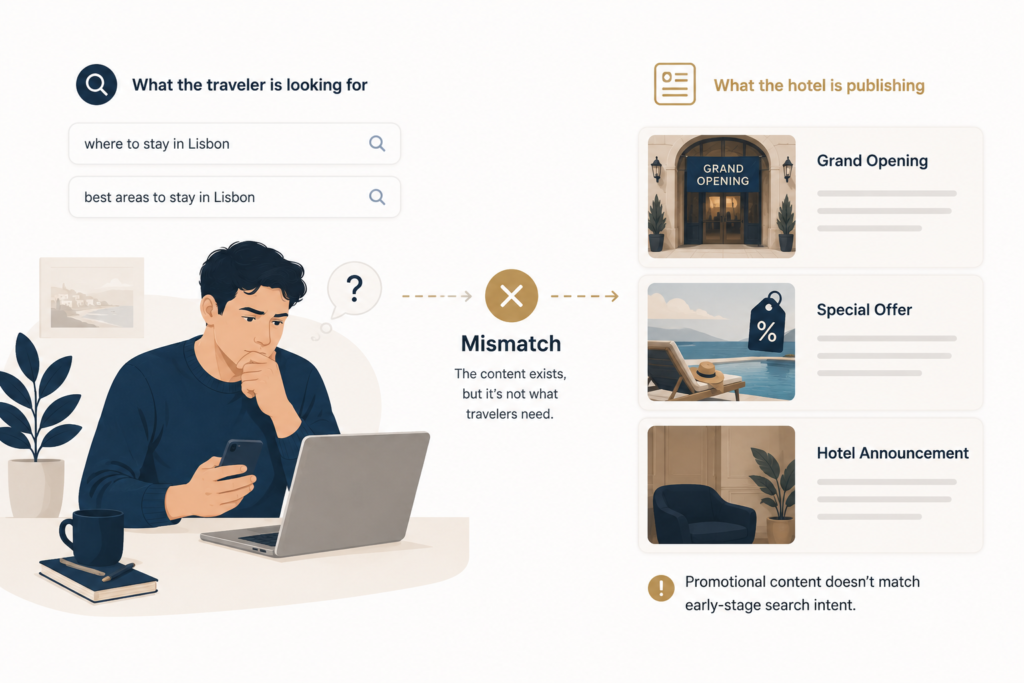
You see things like seasonal promotions, hotel opening announcements, restaurant features, brand storytelling, and company milestones. None of these are inherently wrong. In fact, they’re important for brand communication. But they rarely capture search traffic, because they are not connected to how people search.
The core issue is perspective.
Most hotels create content based on what they want to promote. Search traffic comes from what users are already looking for. And those two things are not the same.
That gap is where most blog strategies break.
Why Publishing More Doesn’t Fix It
There’s a common assumption that if a hotel publishes more content, traffic will follow. In reality, volume is rarely the limiting factor. A hotel can publish dozens of blog posts a year and still see no SEO growth — this is why many hotels don’t get organic traffic despite being active.
Take a typical example. A post like “Celebrate the Grand Opening of Our Luxury Boutique Hotel” might feel important internally. But almost no one is searching for it. It doesn’t connect to an existing demand.
Now compare that to how people actually search.
They’re looking for things like where to stay in Ho Chi Minh City, best areas to stay in Bangkok, district 1 vs district 3, or best boutique hotels near Ben Thanh market. These are not brand queries, they are decision-stage queries.
That’s where traffic comes from.
This is the difference most hotel blogs miss: One type of content assumes demand. The other actually captures it. Without that distinction, blogging turns into content production, not traffic generation. You end up with a library of articles, but no real acquisition channel.
Where Most Hotels Get It Wrong
A lot of people think hotel content fails because it’s low quality or inconsistent. But that’s usually not the case. Many hotels are publishing regularly and investing real effort into content. The problem is not execution, it’s timing.
Most hotel content sits too late in the journey.
It assumes that the traveler already knows the destination, has shortlisted options, and is now evaluating properties. That’s why so much content focuses on rooms, amenities, or brand stories. But by the time a user reaches that stage, the decision context has already been shaped somewhere else, often on OTAs, travel blogs, or search-driven content.
In other words, hotels are trying to compete at the point of selection — where OTAs already dominate visibility, without ever participating in the stage where preferences are formed. And that’s why even “good content” fails, it shows up too late to matter.
What This Looks Like In Practice
If you map out how a traveler actually plans a trip, the process rarely starts with a hotel. It starts with questions.

Where should I stay? Which area fits my travel style? Is it better to stay near the beach or in the city center? Which neighborhoods are safe, convenient, or interesting?
These questions shape demand long before any specific property is considered. Now compare that to how most hotel blogs are written.
There’s a disconnect. Hotels are producing content after the decision has already started narrowing, while search demand is created much earlier. Because of that, they miss the opportunity to become part of the journey in the first place.
A Simple Way To Think About It
Imagine you’re launching a new boutique hotel in Ho Chi Minh City. Most hotels would start their blog with content like: welcome to our new hotel, discover our luxury experience, exclusive opening offers, or meet our dining concept.
All of these are logical from a business perspective. But they speak to people who already know you.
A search-led approach looks very different. Instead of starting from the hotel, it starts from the traveler’s questions. Content would focus on things like where to stay in Ho Chi Minh City for first-time visitors, district 1 vs district 3, best boutique hotels in Ho Chi Minh City, hotels near Ben Thanh market, or best areas for digital nomads in Saigon.
That shift changes the role of the blog completely.
It stops being a place to publish updates, and starts becoming a system to capture demand before brand awareness even exists.
What Actually Works: The 3 Content Layers
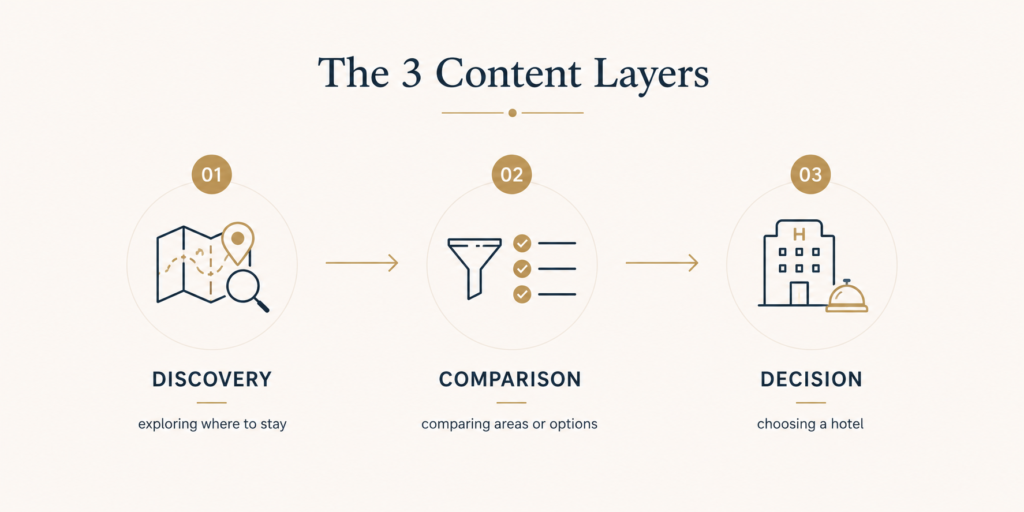
When hotel blogs do generate organic traffic, they usually follow a simple structure built around how people search.
- The first layer is discovery content: This is where travelers are still exploring, they don’t know which hotel to choose yet, they’re trying to understand where to stay. This includes guides, area breakdowns, and first-time visitor recommendations. This is where most traffic begins.
- The second layer is comparison content: At this stage, users are narrowing options. They compare neighborhoods, locations, or travel styles. Content here includes district comparisons, pros and cons of different areas, or recommendations based on specific needs. This is where decisions start to take shape.
- The third layer is decision content: This is where intent becomes specific, users are actively looking for options that match their criteria. This includes queries like best boutique hotels in a city, hotels near a landmark, or hotels for families or couples. The traffic here is lower, but the intent is much higher.
Together, these three layers mirror the actual decision journey. That’s why they consistently outperform generic blog content.
Why Hotels Default To The Wrong Content
If this is so clear, why do most hotels still get it wrong?
Because internal content is easier.
It’s easier to write about your own hotel than to write about a destination. It’s easier to promote what you already know than to research what users are searching. It’s easier to align content with campaigns than with search intent.
There’s also a structural issue. In many hotels, content is owned by marketing teams focused on branding or sales, not by teams focused on SEO or demand generation. So content becomes a communication tool, not a growth system.
Over time, this creates a loop. Content is produced, but it doesn’t drive traffic. Because it doesn’t drive traffic, it’s seen as low-impact. And because it’s seen as low-impact, it never gets treated strategically.
The Bigger Issue Behind It
This is why many hotels feel like they are doing content but seeing no real results. Content exists, but it’s disconnected from growth — this is why many hotels feel like they’re doing SEO but seeing no real results.
Without search-led content, direct traffic stays weak, OTA dependency doesn’t change, paid channels carry most of the acquisition load, and SEO visibility plateaus. Content becomes a cost center instead of a growth lever.
This isn’t a content problem. It’s a strategy problem.
FAQ
Because they focus on internal or promotional topics instead of search-driven demand.
Content aligned with how users search, especially discovery, comparison, and decision-stage topics.
No, but they shouldn’t be the foundation of a traffic strategy.
Start with search-driven topics around destinations and decision-making, not internal announcements.
Yes, but only if it captures demand early in the journey.
From the Author
Thanks for reading Hospitality Insider ☺️

This site is basically where I try to make sense of hospitality marketing while working inside the industry. I’m not an expert, just someone curious enough to observe, analyze, and write things down.
If you have thoughts, different perspectives, or just want to talk about hospitality marketing, feel free to connect with me on LinkedIn.
Vee Nguyen
Founder, Hospitality Insider
If you enjoyed this article, a quick like would mean a lot 💙
Latest Insights
Observations and analysis on hospitality marketing, distribution, and growth.

Why Most Hotel Blogs Fail (Even When They’re Active)
May 10, 2026Publishing more content won’t fix your traffic. Here’s why most hotel blogs fail and how to align content with real search demand.
What Hotel Content Actually Drives Organic Traffic?
April 19, 2026This is why many hotels feel like they are “doing content” but seeing no results.

Can Hotels Really Generate Demand Without OTAs?
April 5, 2026Everyone talks about reducing OTA dependency, but from what I’ve seen, a lot of hotels aren’t even in a position to do that yet