
Why Most Hotels Don’t Get Organic Traffic, and What Needs to Change
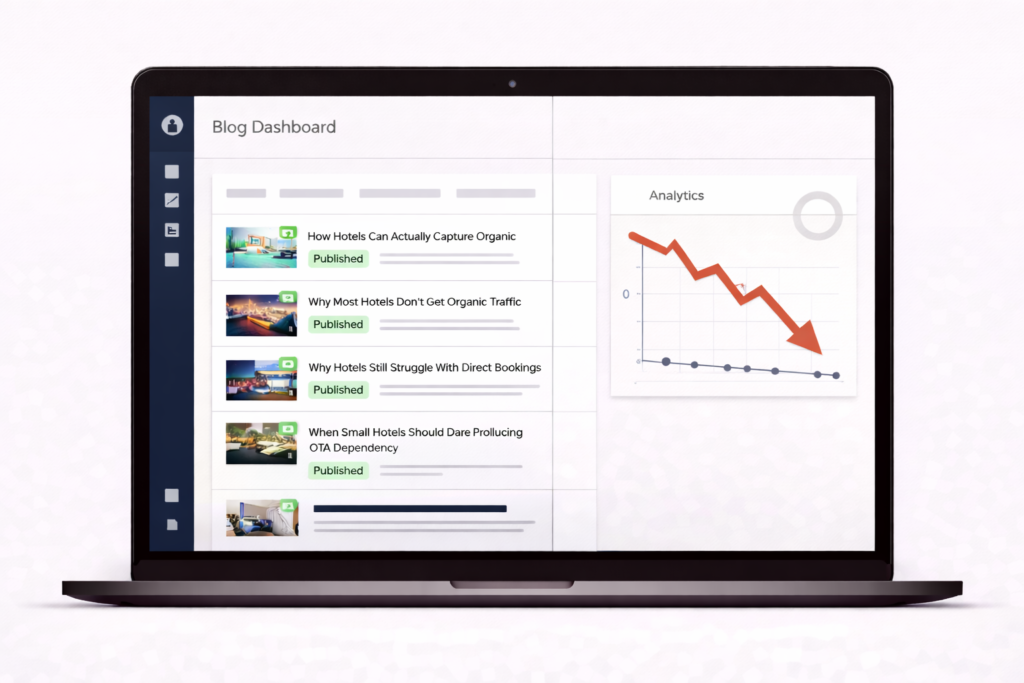
Across many hotel teams, SEO is often seen as something that has already been “tried.” The website has been optimized, keywords have been added, maybe a few blog posts were published, and yet traffic remains low or stagnant. This leads to a common conclusion: SEO doesn’t work for hotels.
But in reality, most hotels are not lacking effort, they are lacking a clear hotel SEO strategy aligned with how travelers actually search.
The deeper problem is that most hotel websites are not designed to capture how travel demand actually forms. They are optimized for visibility at the very end of the journey, when the traveler already knows where they want to stay. By that point, the competition is already dominated by OTAs.
So the real issue is not that SEO doesn’t work.
SEO in hospitality is not a traffic problem.
It’s a timing problem.
How travelers search for hotels (and why most hotel websites don’t show up)
To understand hotel SEO, it’s necessary to step away from the website and look at user behavior. Most travelers do not start with a hotel name in mind. They start with a question, a constraint, or a destination.
A typical journey might begin with searches like “where to stay in Bangkok,” “best areas in Ho Chi Minh City,” or “hotel near Ben Thanh market.” At this stage, the user is not comparing specific properties yet. They are trying to understand geography, price ranges, convenience, and experiences.
This is where most hotel websites disappear completely. Instead, search results are dominated by OTAs, travel publishers, and large content platforms. These players are not necessarily better hotels, but they are better at organizing information around user intent.
By the time the traveler narrows down options and searches for a specific hotel, the decision is already partially made. SEO at that stage becomes defensive rather than growth-oriented.
The three layers of hotel SEO (and where most hotels get stuck)
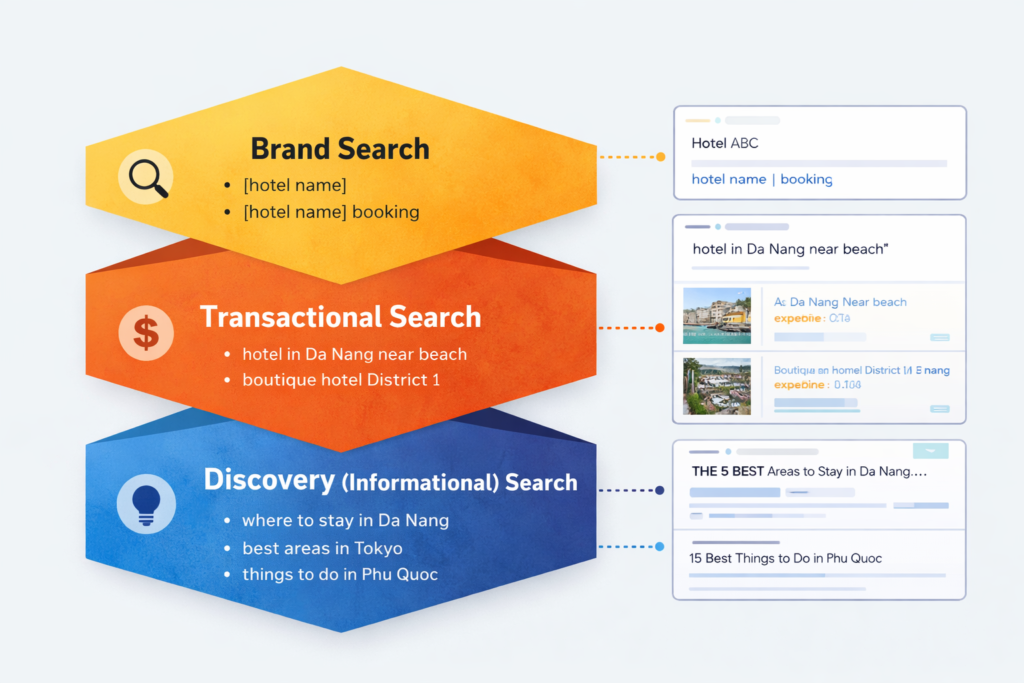
A useful way to think about SEO in hospitality is to break it into three layers: brand, transactional, and discovery.
- The first layer is brand search. This includes queries like the hotel name or “[hotel name] booking.” Almost every hotel ranks here by default. This traffic is important, but it does not represent growth. It simply captures users who already know you.
- The second layer is transactional search, such as “hotel in Da Nang near beach” or “boutique hotel District 1.” This is where booking intent is high, but competition is intense. OTAs dominate this space because they aggregate options and have strong domain authority. Individual hotel websites can compete here, but it requires strong positioning, clear differentiation, and solid on-page optimization.
- The third layer is discovery or informational search. This includes queries like “where to stay in Da Nang,” “best areas in Tokyo,” or “things to do in Phu Quoc.” This is the largest layer in terms of search volume and also the earliest stage in the decision-making process. However, it is also the most underutilized by hotel websites.
Most hotel SEO strategies fail not because they are wrong, but because they are incomplete.
Most hotels focus almost entirely on the first layer and partially on the second. Very few invest meaningfully in the third. As a result, they are not present when the traveler is forming preferences.
Why this gap matters more than traffic
It is easy to think of SEO as a traffic channel. But in hospitality, it is more accurate to think of it as a positioning tool.
If your goal is simply to increase hotel website traffic, then ranking for branded searches may seem sufficient. But if the goal is growth, hotels need to capture demand earlier, where hotel organic traffic is actually generated.
If your website only ranks for branded searches, then your organic traffic reflects existing awareness, not new demand. This means your growth still depends on external platforms such as OTAs, paid ads, or offline exposure.
On the other hand, if your website ranks for discovery queries, it becomes part of the traveler’s decision process. You are no longer just an option; you are part of how the user understands the destination itself.
This shift has a direct impact on direct bookings. When a user discovers your hotel through content that helped them plan their trip, the likelihood of booking directly increases because the relationship starts earlier.
Content in hotel SEO: not blogging, but demand capture
One of the most misunderstood aspects of SEO in hospitality is content. Many hotels either ignore it or treat it as a low-priority blog section with generic articles. In reality, content is the core mechanism through which hotels can enter the discovery phase.
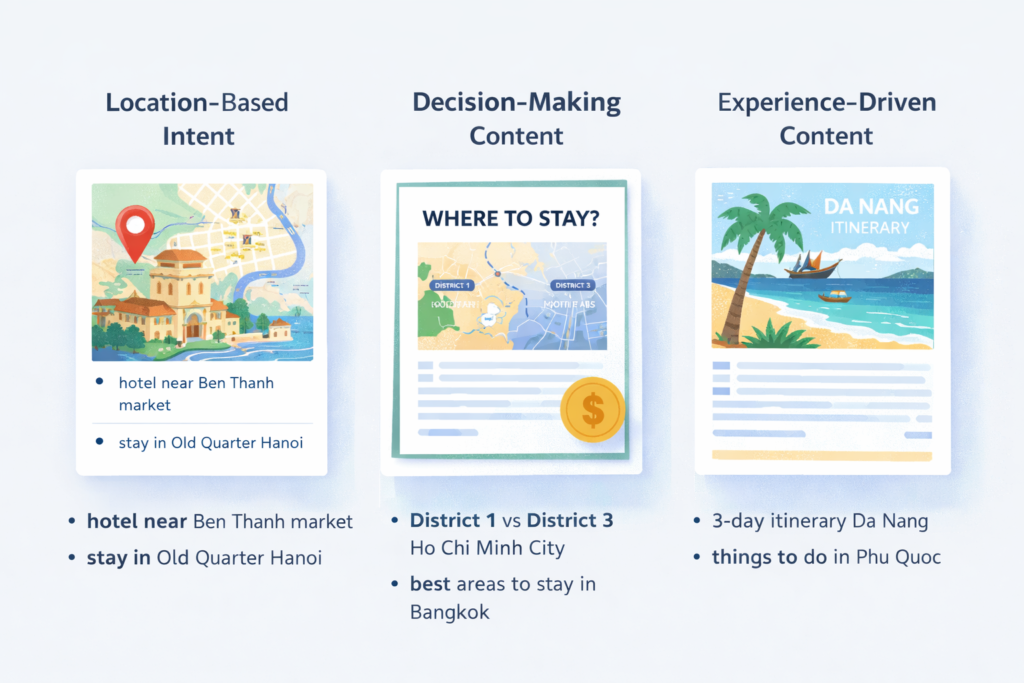
Effective content is not about writing frequently, but about aligning with how people search. In practice, strong hotel SEO content usually falls into three categories.
- The first is location-based intent. This includes pages targeting specific areas, landmarks, or neighborhoods, such as “hotel near Ben Thanh market” or “stay in Old Quarter Hanoi.” These pages connect directly to user constraints and are closer to booking intent.
- The second is decision-making content. These are guides that help users choose between options, such as “District 1 vs District 3 Ho Chi Minh City” or “best areas to stay in Bangkok.” This type of content positions the hotel as part of the recommendation set.
- The third is experience-driven content. These include itineraries, activity guides, and local insights like “3-day itinerary Da Nang” or “things to do in Phu Quoc.” While further from booking, they attract a large audience and build trust.
Most hotel websites lack all three. This is why they fail to capture organic demand beyond branded searches. This is where a strong hotel SEO strategy becomes critical, not just to rank, but to align content with real user intent.
Technical SEO still matters, but it is not the main bottleneck
Technical SEO is often the first thing hotels focus on, and for good reason. Issues like slow page speed, poor mobile experience, and improper indexing can limit visibility.
However, in most cases, technical SEO is not the main reason for low traffic. A technically perfect website with no relevant content will still not rank for meaningful queries.
That said, there are a few fundamentals that hotels should not ignore. The website must load quickly, especially on mobile devices. The structure should be clear and crawlable, with logical internal linking between pages. Metadata and headings should reflect actual search intent rather than generic keywords.
These elements create the foundation, but they do not generate demand on their own.
The role of the website: from brochure to acquisition channel
Many hotel websites are still designed as digital brochures. They showcase rooms, amenities, and images, but they do not function as acquisition channels.
An SEO-driven website behaves differently. It includes entry points for users who are not yet familiar with the hotel. It guides them from exploration to consideration, and eventually to booking.
This requires connecting content with conversion. For example, a guide about “where to stay in Ho Chi Minh City” should naturally introduce the hotel as one of the options, with clear pathways to check availability. Without this connection, traffic does not translate into bookings.
This is where SEO, UX, and conversion strategy intersect. Treating them separately often leads to underperformance.
This also explains why many hotels struggle to increase direct bookings, a topic explored in more detail in a previous article.
Why most hotels struggle to execute SEO properly
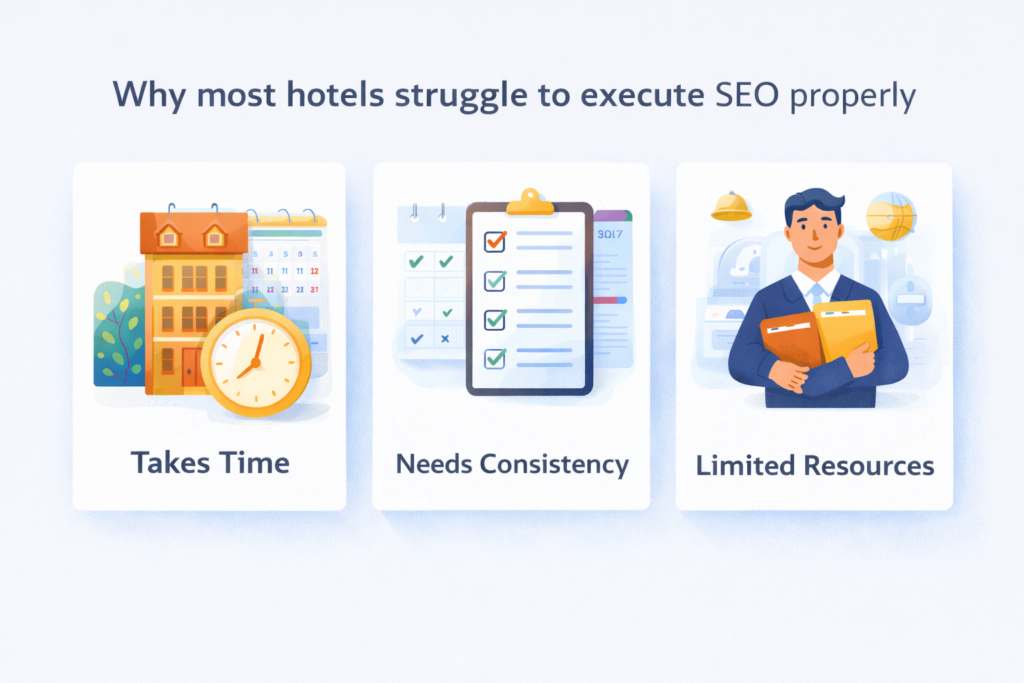
Even when hotels understand the importance of SEO, execution is often inconsistent. There are several practical constraints.
- First, SEO takes time. Unlike OTAs, which deliver immediate bookings, organic search is a long-term investment. This makes it harder to prioritize, especially for teams under revenue pressure.
- Second, content requires consistency. Publishing a few articles does not create meaningful results. It requires a structured approach over months, sometimes years.
- Third, internal resources are limited. Many hotels do not have dedicated SEO or content teams. Marketing responsibilities are often spread across multiple functions.
Finally, ROI is not always immediately visible. This makes it difficult to justify continued investment without a clear measurement framework.
These challenges explain why SEO is often underdeveloped, even when its potential is understood.
What effective hotel SEO looks like in practice
Hotels that succeed with SEO tend to approach it as a system rather than a set of tactics. Their websites rank not only for their brand, but also for destination-related queries. Their content reflects real traveler questions, not just keyword lists.
They build pages that are both informative and conversion-oriented, ensuring that users can move seamlessly from reading to booking. They also monitor performance over time, understanding which topics drive traffic and which contribute to revenue.
Importantly, they do not expect immediate results. Instead, they treat SEO as a compounding asset that strengthens over time.
FAQ: Hotel Website SEO
SEO is a long-term channel. Most hotels start seeing meaningful organic growth after 4 to 6 months, with stronger results appearing after 9 to 12 months, depending on competition and consistency.
SEO and OTAs serve different roles. OTAs provide immediate demand, while SEO builds long-term visibility and reduces dependency over time. The goal is not to replace OTAs completely, but to balance distribution.
Yes, especially if they focus on niche positioning and specific traveler segments. Smaller hotels can compete more effectively in long-tail and location-based searches than in broad, high-competition keywords.
There is no fixed number, but consistency matters more than volume. A structured approach with 2–4 high-quality pieces per month is often more effective than publishing many low-quality articles.
Yes, but indirectly. SEO brings in traffic earlier in the decision journey, builds trust, and increases the likelihood that users will book directly instead of returning to OTAs.
From the Author
Thanks for reading Hospitality Insider ☺️

This site is basically where I try to make sense of hospitality marketing while working inside the industry. I’m not an expert, just someone curious enough to observe, analyze, and write things down.
If you have thoughts, different perspectives, or just want to talk about hospitality marketing, feel free to connect with me on LinkedIn.
Vee Nguyen
Founder, Hospitality Insider
If you enjoyed this article, a quick like would mean a lot 💙
Latest Insights
Observations and analysis on hospitality marketing, distribution, and growth.

Why Most Hotel Blogs Fail (Even When They’re Active)
May 10, 2026Publishing more content won’t fix your traffic. Here’s why most hotel blogs fail and how to align content with real search demand.
What Hotel Content Actually Drives Organic Traffic?
April 19, 2026This is why many hotels feel like they are “doing content” but seeing no results.

Can Hotels Really Generate Demand Without OTAs?
April 5, 2026Everyone talks about reducing OTA dependency, but from what I’ve seen, a lot of hotels aren’t even in a position to do that yet