
How Hotels Can Actually Capture Organic Demand (A Practical SEO Approach)
There’s a quiet misconception in hospitality marketing: SEO is acknowledged as important, but rarely treated as urgent.
In most hotel teams, it sits somewhere behind performance campaigns, OTA distribution, and short-term revenue targets. As a result, it never gets the level of focus needed to actually work.
Over time, this creates a structural issue. Hotels become extremely good at capturing demand that already exists (mostly through OTAs and paid channels), but very weak at generating or capturing demand earlier in the journey. SEO was supposed to solve this, but in reality, most hotels never execute it properly.
The Core Problem: Hotels Only Compete at the Bottom of Demand
Most hotel SEO efforts focus on keywords like:
- “Hotel in ho chi minh city”
- “Boutique hotel district 1”
- “Hotel near ben thanh market”
These are high-intent, bottom-funnel queries. The problem is not that these keywords are wrong, it’s that they represent only a very small portion of total demand.
They capture demand, but they don’t create it.
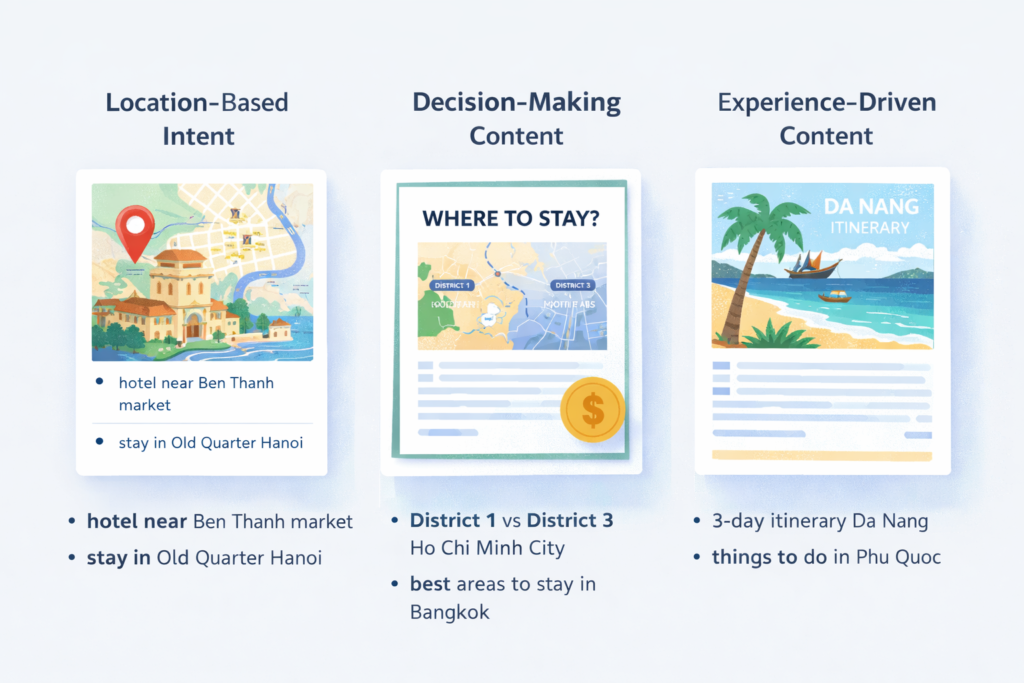
Organic demand actually starts much earlier, when travelers are still figuring things out. Typical search behavior looks more like:
- “Where to stay in Ho Chi Minh city”
- “District 1 vs district 3”
- “Best areas for nightlife in Saigon”
- “Is district 1 safe”
If a hotel only shows up at the final step, it is competing for demand that has already been shaped, often by OTAs (Booking.com, Expedia…), blogs, or aggregators. This is also closely related to why many hotels struggle to increase direct bookings, not because of a lack of channels, but because they enter the journey too late. At that point, differentiation becomes much harder, and price or reviews tend to dominate the decision.
This is where organic demand is shaped, long before a hotel ever enters the consideration set.
Why Hotel SEO Usually Fails (In Practice)
1. The Website Is Built Around Inventory, Not Intent
Most hotel websites are structured around rooms, facilities, and promotions. That makes sense operationally, but it does not align with how people search. Users don’t start with your room types, they start with questions, uncertainty, and preferences. They start with uncertainty, not inventory.
This creates a disconnect between what hotels publish and what users are actually looking for. SEO breaks not because of technical issues, but because of this fundamental mismatch.
2. “Doing Content” Without a Strategy
Many hotels technically have a blog, but if you look closely, it’s usually filled with generic topics like:
- Top things to do in [destination]
- Why visit [city]
- Hotel updates
These articles are often written without clear intent targeting, without internal linking, and without any role in the booking journey. As a result, they don’t rank, don’t drive meaningful traffic, and don’t influence decisions.
Content exists, but it doesn’t function as a system.
3. SEO Is Treated as a Side Project
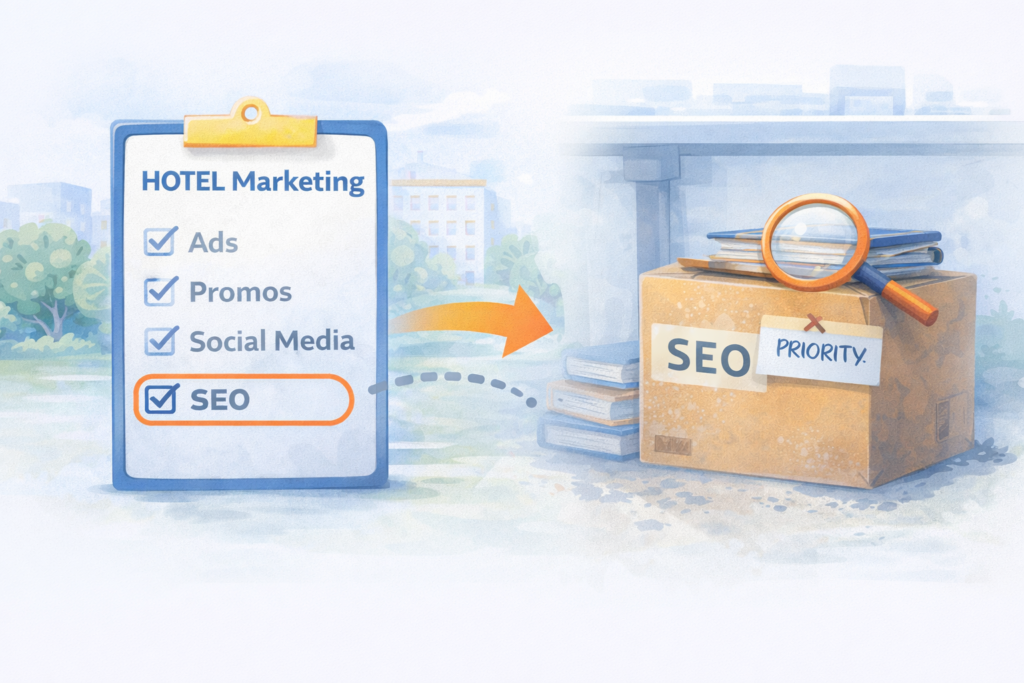
In many teams, SEO sits in a gray area. It’s not a core KPI for marketing managers, not directly tied to revenue like paid ads, and often outsourced without strategic direction. This leads to inconsistent execution, no feedback loop, and no long-term compounding.
What happens next is predictable: the hotel “tries SEO” for a few months, sees little impact, and shifts focus back to channels that deliver faster results.
SEO doesn’t fail because it doesn’t work.
It fails because it’s never given the conditions to compound.
What Organic Demand Actually Looks Like in Hospitality
To approach SEO properly, hotels need to reframe what organic demand is. It’s not just transactional keywords, it’s the entire decision-making surface.
This includes:
- Destination intent: where to stay, which areas to choose
- Experience intent: quiet vs nightlife, luxury vs budget
- Problem-based queries: early check-in, family-friendly options
- Comparison queries: district vs district, hotel vs hotel
Most of these searches happen before a user is even thinking about a specific hotel. That’s exactly why they matter, this is where decisions are shaped.
Most hotel SEO strategies ignore this layer entirely.
A Practical SEO Approach That Actually Works
Instead of asking:
“How do we get more traffic?”
A better question is:
“Where does demand exist that we are not part of yet?”
1. Map Demand Before Writing Anything
Before writing anything, map out:
- What people search before booking a hotel in your destination
- How those searches evolve across the decision journey
This is not just keyword research, it’s intent mapping.

For example:
| Stage | Search Type | Example |
|---|---|---|
| Discovery | Destination | “where to stay in ho chi minh” |
| Consideration | Area | “district 1 vs district 3” |
| Preference | Experience | “quiet hotels district 1” |
| Decision | Brand | “[hotel name] reviews” |
Most hotels only show up at the last stage.
SEO is about showing up earlier.
2. Build Content Around Decision Moments, Not Topics
Content should exist to help users make decisions, not just to “have something on the blog.” The difference is subtle but critical.
Strong topics usually sound like:
- “Should I stay in District 1 or District 3?”
- “Is it worth staying near Ben Thanh Market?”
- “What area is best for nightlife vs quiet stays?”
These queries reflect real uncertainty, and answering them positions the hotel inside the decision process. That’s where influence, and eventually conversion, happens.
3. Structure Content Like a System, Not a Blog
SEO works when content pieces reinforce each other. Instead of publishing random posts, structure them into a system:
- One pillar page (e.g. where to stay in ho chi minh city)
- Multiple supporting articles (district breakdowns, comparisons, niche needs)
- Internal linking connecting everything together
This improves topical authority, helps search engines understand relevance, and creates a smoother experience for users navigating the site.
4. Tie SEO to the Booking Journey
Traffic alone has limited value if it doesn’t lead anywhere. Each content piece should naturally connect to a relevant part of the booking journey.
SEO without conversion thinking is just traffic.
For example:
An article about “quiet areas to stay” should link to:
- Rooms with soundproofing
- Upper-floor options
- Longer-stay packages
This is where many hotels fail, they generate traffic but don’t capture value.
5. Consistency > Perfection
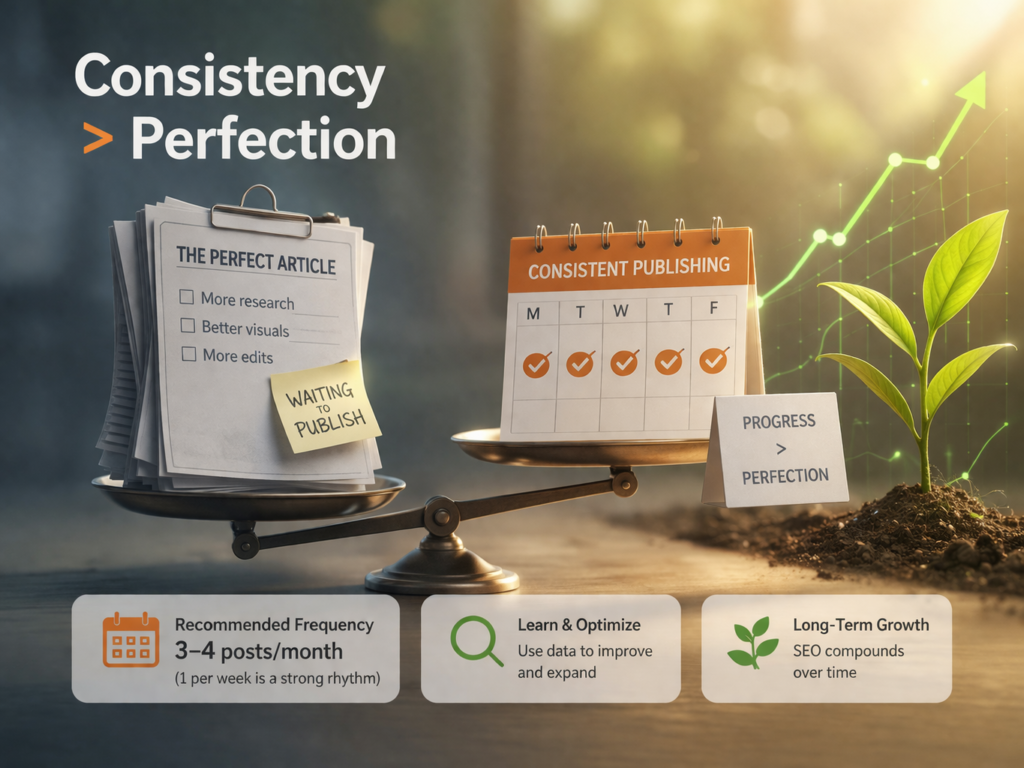
One of the most common blockers in hotel SEO is overthinking content quality. Teams wait for the “perfect article,” which slows down output and kills momentum.
Hotels that win in SEO are not the ones with the best single article. They’re the ones that:
- Publish consistently
- Learn from performance
- Expand based on real search behavior
SEO is not a campaign, it’s a system that compounds over time.
What the Data (and Reality) Suggest
Across industries, not just hospitality, organic search consistently drives:
- ~50–60% of website traffic for content-driven sites
- Lower customer acquisition cost compared to paid channels
- Higher trust and conversion intent in mid-to-late funnel stages
Yet in hospitality, organic often contributes a disproportionately small share of bookings.
Not because the channel is weak, but because execution is.
Hotels underinvest in:
- Content depth
- SEO structure
- Internal linking
- Long-tail demand
So they never see the compounding effect.
The Shift Hotels Actually Need
Capturing organic demand requires a mindset shift:
From:
- “How do we rank for hotel keywords?”
To:
- “How do we become part of how travelers decide where to stay?”
This means:
Building content that supports decisions, not just promotes rooms
Thinking beyond your property
Understanding traveler intent
This also ties back to a broader challenge in hospitality marketing, balancing OTA dependency while building sustainable, direct demand channels.
FAQ
Typically 3–6 months for early traction, and 6–12 months for meaningful impact. SEO compounds over time, so consistency matters more than speed.
Both matter, but they serve different roles:
- Local SEO captures existing demand (e.g. “hotel near me”)
- Content SEO creates and captures new demand earlier in the journey
Most hotels over-focus on local SEO and ignore content.
Yes, especially in long-tail and destination-specific queries.
Large brands often focus on scale, leaving gaps in:
- Area-specific content
- Experience-driven queries
- Niche traveler needs
Boutique hotels can win there with focused content.
Outsourcing execution is fine.
Outsourcing thinking is risky.
Hotels still need:
- Internal understanding of demand
- Clear content direction
- Ownership of strategy
Otherwise SEO becomes disconnected from actual business goals.
From the Author
Thanks for reading Hospitality Insider ☺️

This site is basically where I try to make sense of hospitality marketing while working inside the industry. I’m not an expert, just someone curious enough to observe, analyze, and write things down.
If you have thoughts, different perspectives, or just want to talk about hospitality marketing, feel free to connect with me on LinkedIn.
Vee Nguyen
Founder, Hospitality Insider
If you enjoyed this article, a quick like would mean a lot 💙
Latest Insights
Observations and analysis on hospitality marketing, distribution, and growth.

Why Most Hotel Blogs Fail (Even When They’re Active)
May 10, 2026Publishing more content won’t fix your traffic. Here’s why most hotel blogs fail and how to align content with real search demand.

What Hotel Content Actually Drives Organic Traffic?
April 19, 2026This is why many hotels feel like they are “doing content” but seeing no results.

Can Hotels Really Generate Demand Without OTAs?
April 5, 2026Everyone talks about reducing OTA dependency, but from what I’ve seen, a lot of hotels aren’t even in a position to do that yet