
Can Hotels Really Generate Demand Without OTAs?

Everyone talks about reducing OTA dependency, but from what I’ve seen, a lot of hotels aren’t even in a position to do that yet. Some don’t have a proper website, and even when they do, it’s often static, with no content and no real entry points from search.
In many cases, what hotels call a “website” is just a digital brochure with a booking engine attached. It exists, but it does not participate in how travelers actually discover destinations or make decisions.
So the question isn’t really “how to reduce OTAs?”. The more useful question is whether hotels can generate demand on their own in the first place, before even thinking about shifting distribution.
1. OTAs Don’t Create Demand. They Capture It.
There is a persistent belief in the industry that OTAs somehow generate demand, but if you look closely at user behavior, that assumption does not really hold. Demand already exists before OTAs enter the picture.
Travelers are already searching:
- Where to stay in Da Nang
- Best areas in Ho Chi Minh City
- Beachfront resorts in Phu Quoc
- Hotels near Ben Thanh market
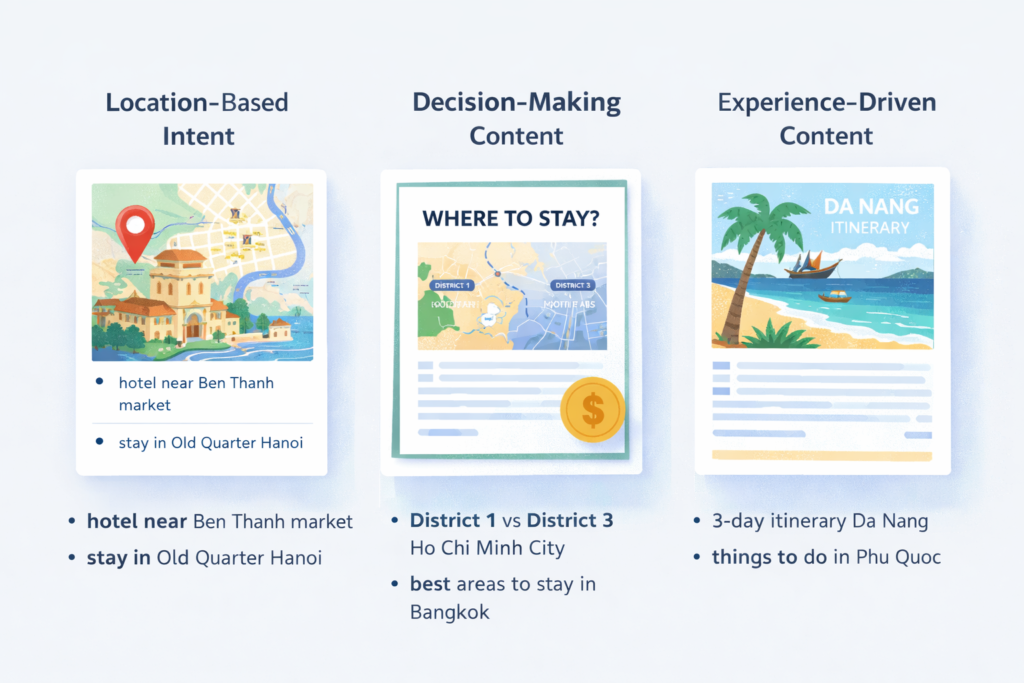
What OTAs do extremely well is positioning themselves right at that moment. They aggregate options, simplify comparison, and dominate search visibility across thousands of these queries.
From a system perspective, OTAs win because they sit exactly where demand already exists. They are not the source of demand, they are the most efficient layer capturing it.
I explored this a bit more in a previous article on OTA dependency, but the key takeaway is simple. If you are not present where demand is formed, you are automatically dependent on whoever is.
2. Most Hotels Don’t Operate in the Demand Creation Stage
If you map out how most hotels approach marketing, there is a clear imbalance. The majority of effort is concentrated at the bottom of the funnel, where demand already exists and competition is the highest.
Typical focus areas include:
- OTA listing optimization
- Pricing and revenue management
- Promotions and packages
- Paid ads targeting transactional keywords
- Conversion rate improvements
All of these are important, but they operate too late in the journey. Very few hotels invest in the earlier stages where travelers are still exploring options and forming preferences.
What is usually missing:
- No blog or content hub
- No destination or area guides
- No visibility on “where to stay” searches
- No long tail SEO strategy
- No informational content that builds context
Hotels are not losing at SEO because they are doing it poorly.
They are losing because they are not even present where demand begins.
This directly connects to the SEO article. The problem is not execution quality, it is absence from the discovery stage.
3. Without Demand Creation, Direct Booking Is Just Redistribution
This is probably the most uncomfortable part of the discussion, but it is also the most important. If a hotel is not creating demand, then increasing direct bookings is not really growth, it is redistribution.
Let’s break down what actually happens in most cases:
- The traveler has already chosen the destination
- They search and land on OTA platforms
- They compare multiple properties within that ecosystem
- The hotel then tries to pull them back through:
- Slightly lower prices
- Member discounts
- Retargeting ads
- “Book direct” perks
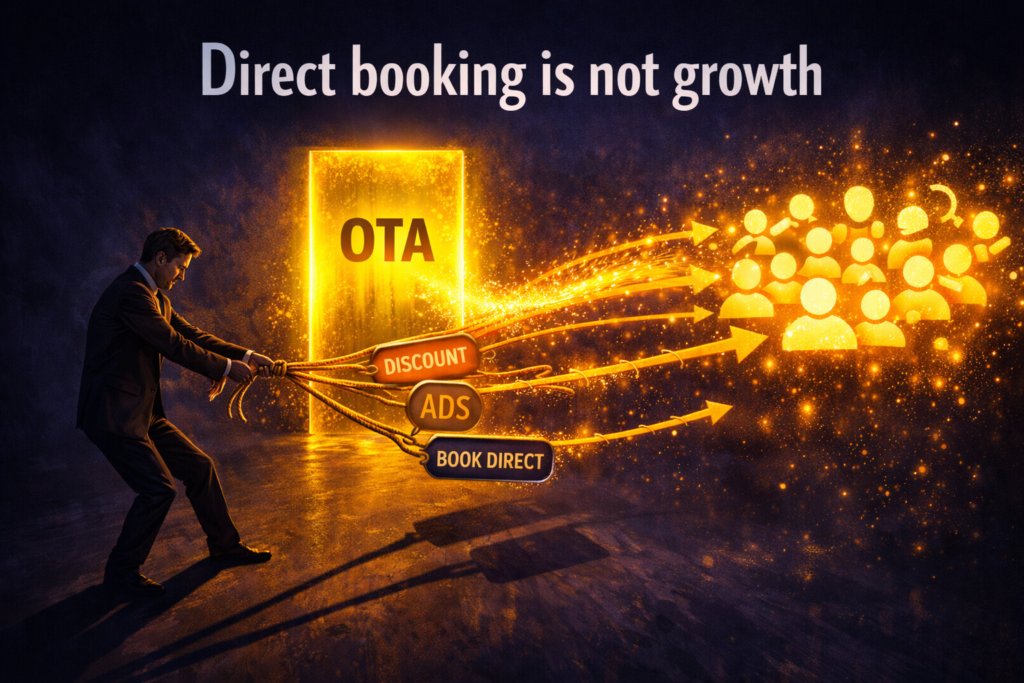
At this stage, the demand already belongs to the OTA environment. The hotel is not generating new demand, it is trying to intercept existing demand.
That is why many direct booking strategies feel:
- Expensive to sustain
- Heavily reliant on paid channels
- Limited in scalability
- Difficult to differentiate
Because they operate too late in the funnel.
The core issue is not conversion. It is that hotels are not influencing the decision early enough. This is also why direct booking conversations often feel tactical, while the real problem is structural.
4. Demand Creation Requires a Different System
If hotels want to generate demand instead of just capturing it, the system needs to change. This is not about adding one tactic, but about building a different layer in the marketing stack.
There are three core components that need to work together.
Content. Where Demand Actually Begins
Demand does not start on booking pages. It starts much earlier, when travelers are still trying to understand a destination.
Typical early stage queries include:
- Where to stay in Ho Chi Minh City
- Best neighborhoods for first time visitors
- Is District 1 or District 3 better
- What area is good for nightlife
- Where to stay near the beach in Phu Quoc
This is where decisions begin to take shape. And today, this space is dominated by OTAs, travel blogs, and large publishers.
Hotels rarely appear here because they do not produce this type of content. Without content, there is no entry point into early stage demand.

Distribution. Content Alone Is Not Enough
Creating content is only one part of the system. If that content is not distributed, it will not generate traffic or demand.
Effective distribution typically includes:
- SEO to capture search intent
- Internal linking to build content clusters
- Social media to amplify reach
- Sometimes paid distribution to accelerate visibility
Most hotels rely almost entirely on OTA platforms for visibility. As a result, they have very little presence in search or social ecosystems outside of brand keywords.
This creates a dependency loop. No distribution leads to no traffic, and no traffic reinforces reliance on OTAs.
Website. From Conversion Tool to Entry Point
Another major limitation is how hotel websites are positioned. In many cases, the website is treated purely as a conversion layer.
Typical structure:
- Homepage
- Room pages
- Facilities
- Booking engine
This works for users who already know the hotel. It does not work for users who are still exploring where to stay.
If hotels want to generate demand, the website needs to function as:
- A discovery platform
- A content hub
- A decision support tool
Not just a place where transactions happen.
This shift is subtle but critical. It changes the role of the website from passive to active in the demand generation process.
5. So Can Hotels Actually Do It
The short answer is yes, but the longer answer is more nuanced.
Hotels can generate their own demand, but it requires a different mindset and a longer time horizon than most are used to.
This is not:
- A quick SEO fix
- A website redesign project
- A campaign that delivers immediate results
It is a system that needs to be built over time.
What makes it difficult is not complexity, but consistency. Hotels need to continuously create content, distribute it, and refine it based on performance.
In practical terms, this means:
- Publishing regularly, even if not perfect
- Learning from search data and user behavior
- Expanding content based on what actually works
- Integrating marketing efforts instead of treating them separately
This is where many hotels struggle. Not because they cannot do it, but because it requires a shift from short term performance thinking to long term demand building.
It Was Never Just About Distribution
Reducing OTA dependency sounds like a distribution problem, but in reality, it is a demand problem first. As long as hotels focus only on capturing demand, they will always be competing inside ecosystems they do not control.
The real shift happens when hotels start building demand themselves and become visible earlier in the journey. That is when distribution becomes a choice, not a dependency.
Until then, OTAs will continue to dominate, not because they are unbeatable, but because they are present where hotels are not.
FAQ
In most cases, completely removing OTAs is not realistic. They provide immediate visibility and access to global demand. The goal should be to balance distribution, not eliminate OTAs entirely.
Because it requires capabilities that go beyond traditional hotel marketing. This includes content strategy, SEO, and multi channel distribution, all of which take time to build and are not always prioritized in daily operations.
Unlike paid channels, demand generation is a long term effort. It can take several months before content starts ranking and generating traffic, but the results tend to compound over time.
A practical starting point is creating content around early stage search queries. Topics like where to stay, area guides, and travel planning content can create entry points and gradually build organic visibility.
From the Author
Thanks for reading Hospitality Insider ☺️

This site is basically where I try to make sense of hospitality marketing while working inside the industry. I’m not an expert, just someone curious enough to observe, analyze, and write things down.
If you have thoughts, different perspectives, or just want to talk about hospitality marketing, feel free to connect with me on LinkedIn.
Vee Nguyen
Founder, Hospitality Insider
If you enjoyed this article, a quick like would mean a lot 💙
Latest Insights
Observations and analysis on hospitality marketing, distribution, and growth.

Why Most Hotel Blogs Fail (Even When They’re Active)
May 10, 2026Publishing more content won’t fix your traffic. Here’s why most hotel blogs fail and how to align content with real search demand.
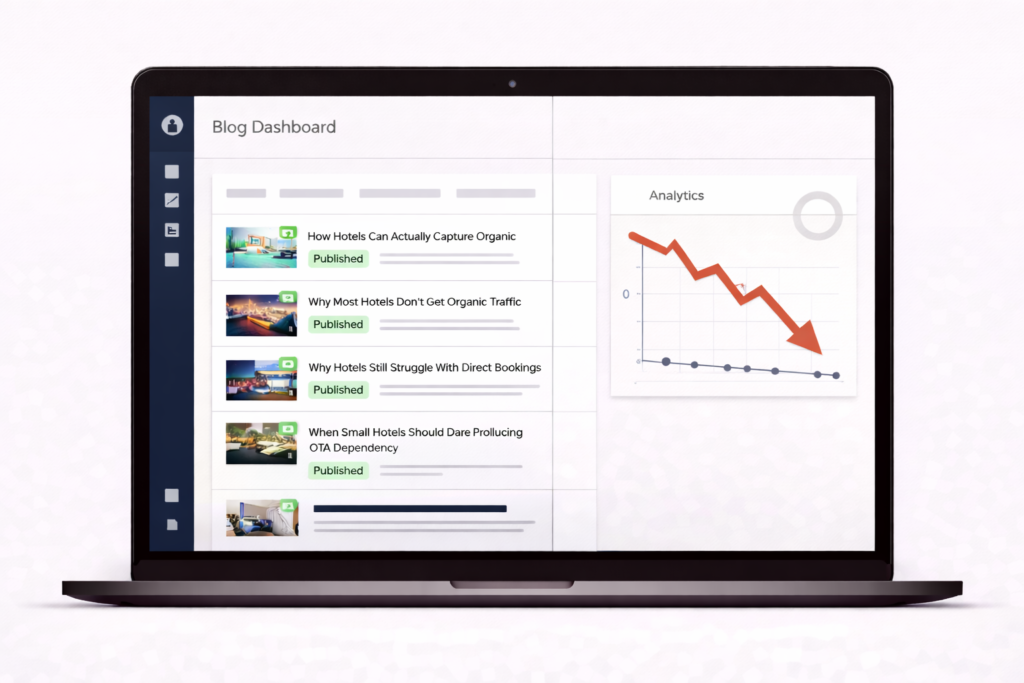
What Hotel Content Actually Drives Organic Traffic?
April 19, 2026This is why many hotels feel like they are “doing content” but seeing no results.

Can Hotels Really Generate Demand Without OTAs?
April 5, 2026Everyone talks about reducing OTA dependency, but from what I’ve seen, a lot of hotels aren’t even in a position to do that yet