
Why Hotels Still Struggle With Direct Bookings
Many hotels say they want more direct bookings, but even after investing in websites, SEO, and paid ads, most still struggle to make it work.
- According to Phocuswright, OTAs account account for 55% of the market in 2024 and increase to 58% by 2026
- In Europe, OTA share is even higher, often exceeding 60% for independent hotels
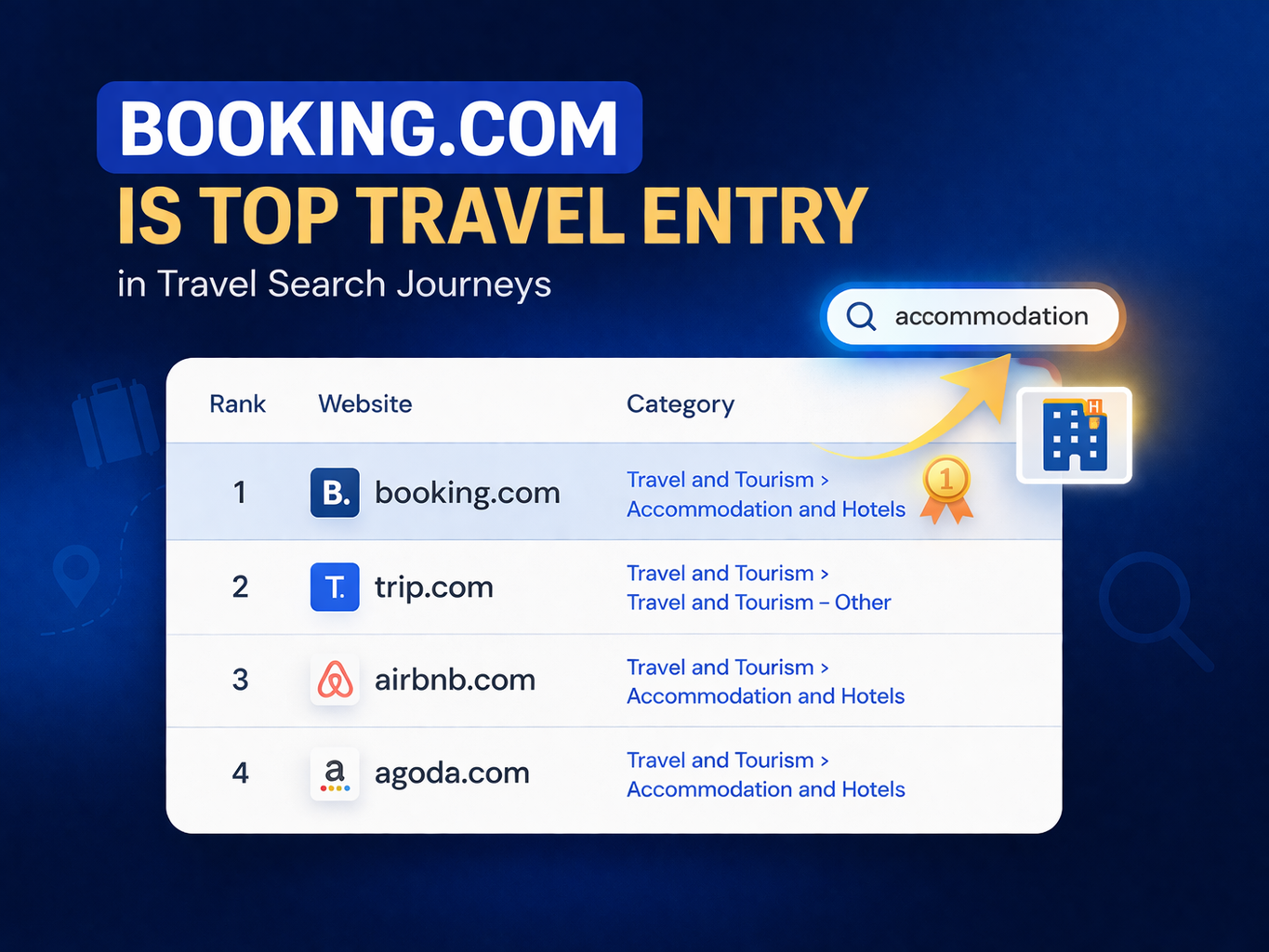
- Data from Similarweb shows platforms like Booking.com frequently rank among the top entry points in travel search journeys, sometimes ahead of Google for accommodation-specific intent
This tells us something important: Direct booking hasn’t failed because hotels are not trying. It remains difficult because consumer behavior is structurally aligned with OTA ecosystems.
Hotels don’t lack channels, they lack demand ownership
As discussed in a previous article on OTA dependency, OTAs are effective at capturing demand, but they don’t help hotels build long-term ownership of that demand.
Most discussions around direct bookings focus on channels: website, booking engine, or paid campaigns. But the core issue sits earlier in the journey.
Google itself has acknowledged that over 70% of travelers start their journey without a specific brand in mind (Google Travel Insights). Instead, they search by destination, intent, or constraints. Queries like “hotel in Da Nang near the beach” or “best areas to stay in Tokyo” naturally lead users to platforms that aggregate options.
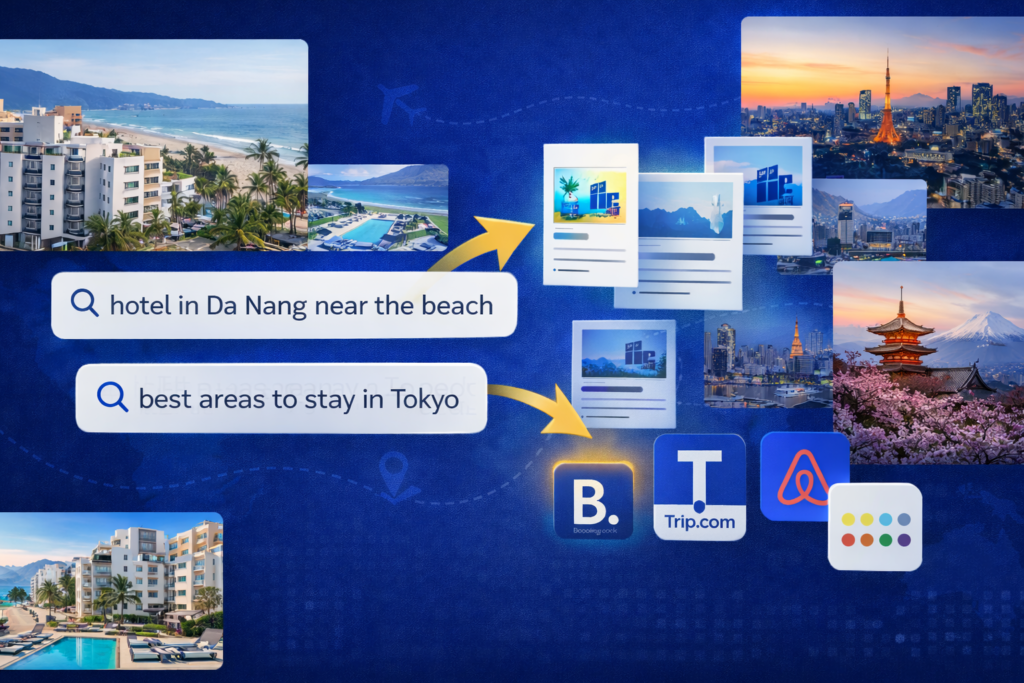
OTAs dominate this layer because they are built to capture and organize demand at scale. They rank for high-intent keywords, invest heavily in paid acquisition, and provide comparison in a single interface.
Hotels, on the other hand, mostly operate at the brand level. Without strong brand demand, they are simply not part of the initial consideration set.
And this is exactly where OTAs win.
A 2025 SEO benchmark study by SEMrush (Travel vertical) showed that:
- OTAs dominate top 10 rankings for high-intent keywords like “hotels in [city]”
- Individual hotel websites rarely rank unless they have strong brand authority or belong to large chains
This means hotels are largely absent from the first touchpoint of demand.
Even when traffic is captured, conversion favors OTAs
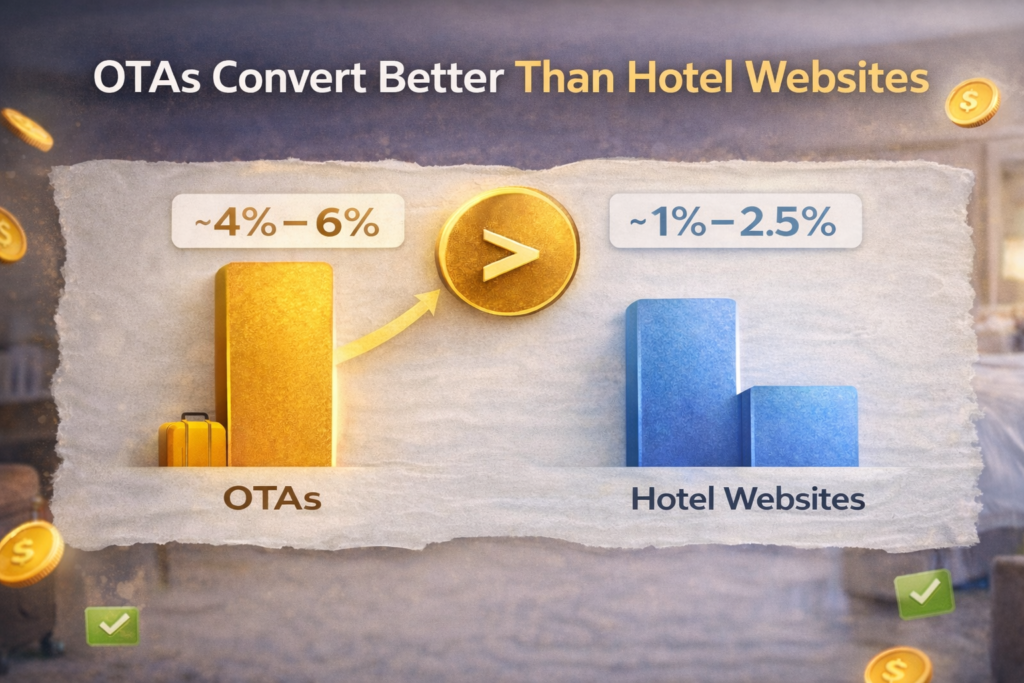
Driving users to a hotel website does not guarantee bookings. In many cases, the conversion gap between OTA platforms and hotel websites is significant.
Industry benchmarks (2024–2025):
- OTA conversion rates: ~4% – 6%
- Hotel website conversion rates: ~1% – 2.5% (often lower for independent properties)
(Source: combined benchmarks from Mirai, Cloudbeds, and SiteMinder reports)
Common friction points include:
- Slow or poorly optimized mobile experience
- Booking engines that feel disconnected from the main site
- Lack of clear pricing or parity confusion
- Limited trust signals such as reviews or guarantees
In contrast, OTAs have spent years refining conversion mechanics. They combine usability, urgency cues, social proof, and flexible policies into a highly optimized flow.
From a user perspective, booking through an OTA often feels faster, safer, and more predictable. As a result, even when hotels succeed in generating traffic, a portion of that demand leaks back to OTA platforms.
Price advantage is not as decisive as hotels assume
Many hotels rely on the assumption that: lower direct price = more direct booking. But real behavior suggests otherwise.
A study by Cornell School of Hotel Administration found: Even when direct prices were slightly lower, a large portion of users still chose OTAs due to perceived trust and convenience
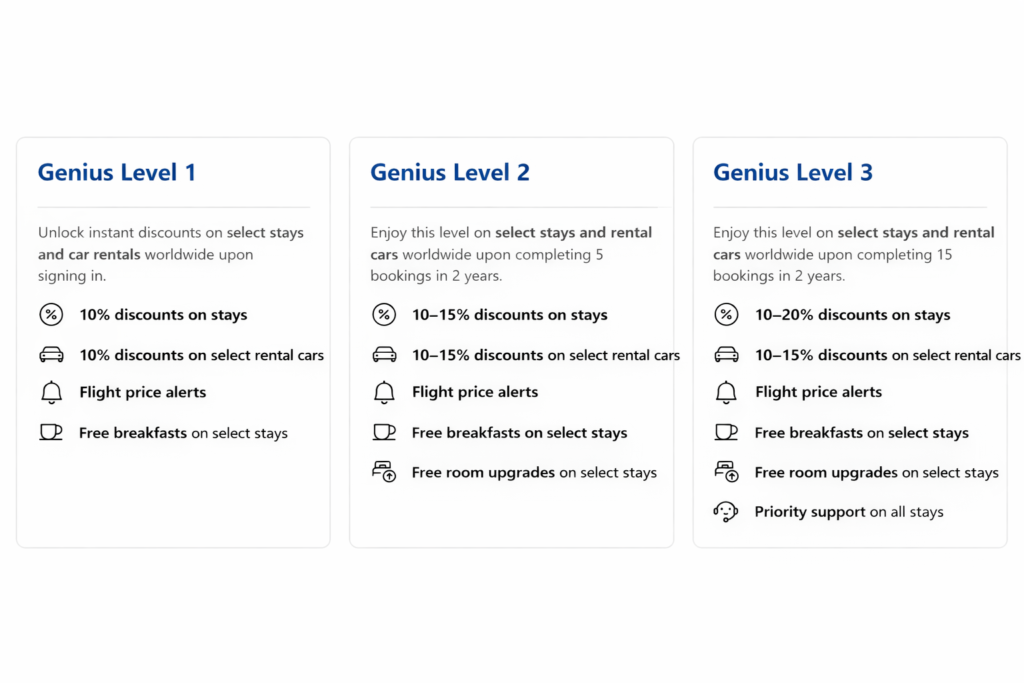
Additionally, Booking.com’s Genius program and OTA loyalty systems often neutralize price advantages through discounts and perks
So pricing alone does not overcome:
- Habit
- Trust
- UX superiority
Paid acquisition is getting more expensive, and less efficient
On paper, replacing OTA commissions with paid marketing sounds logical. In practice, it is difficult to execute efficiently.
Hotels competing on Google Ads often face:
- High cost-per-click driven by OTA bidding pressure
- Lower conversion rates compared to OTA platforms
- Limited ability to optimize across large datasets
As a result, customer acquisition costs for direct bookings can approach, or even exceed, OTA commission levels. The difference is that OTAs operate with scale and data advantages, while hotels manage campaigns in isolation.
According to Skift & Google travel reports (2025):
- Travel CPCs increased significantly post-pandemic due to demand recovery
- OTAs are among the largest spenders on Google Ads globally
This creates a bidding environment where:
- Hotels compete directly with OTAs on their own brand terms
- Customer acquisition cost via paid channels can reach 10–30% of booking value, depending on market
Which is often:
→ equal to or higher than OTA commissions
This explains why many “shift to direct via ads” strategies fail financially.
Retention gap: OTAs keep the customer, hotels don’t
One of the clearest structural disadvantages is data ownership.
Many hotels still do not have:
- A properly implemented CRM
- Automated email or lifecycle marketing
- Consistent data capture across touchpoints
- Retargeting strategies based on first-party data
Without these elements, every booking becomes a new acquisition effort. There is little compounding effect over time.
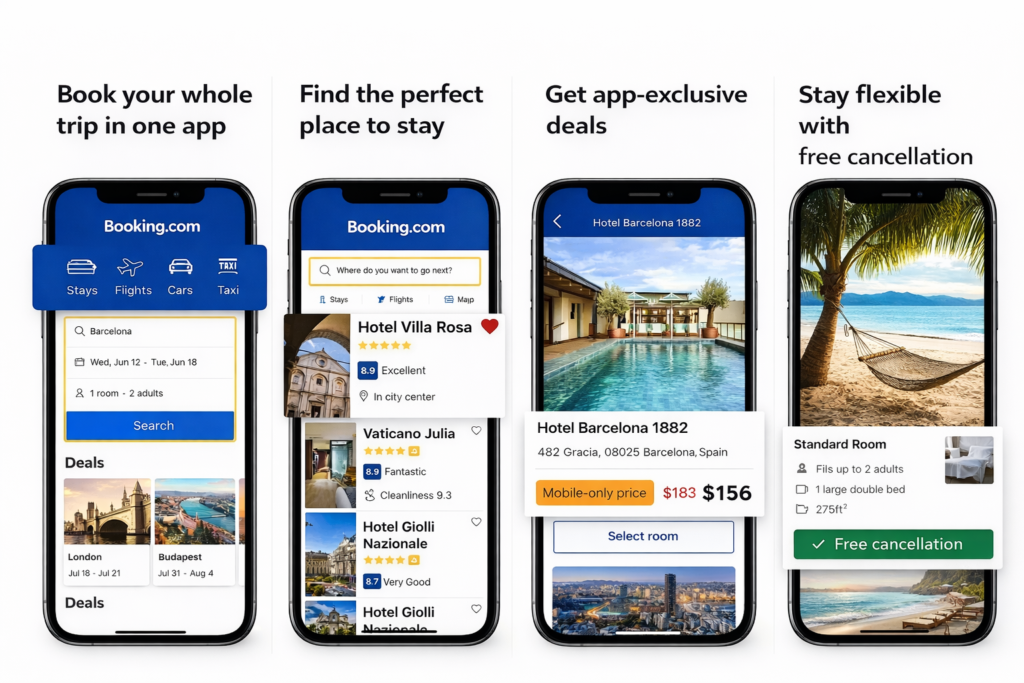
OTAs, by contrast, are designed to bring users back repeatedly. They retain customer data, control communication channels, and continuously remarket to past users.
- OTAs control user accounts, booking history, and behavioral data
- Platforms like Booking.com and Expedia run large-scale email, app, and retargeting ecosystems
This leads to a simple dynamic:
- Hotels acquire bookings
- OTAs retain customers
SEO and content: the biggest missed opportunity
Search demand in travel is heavily skewed toward informational queries. Google data shows that:
- A large portion of travel searches are non-branded and exploratory
- Queries like “where to stay in…” or “things to do in…” dominate early journey stages
These queries represent early-stage intent, where decisions begin to form. OTAs and large publishers dominate this space, capturing users before they are ready to book.
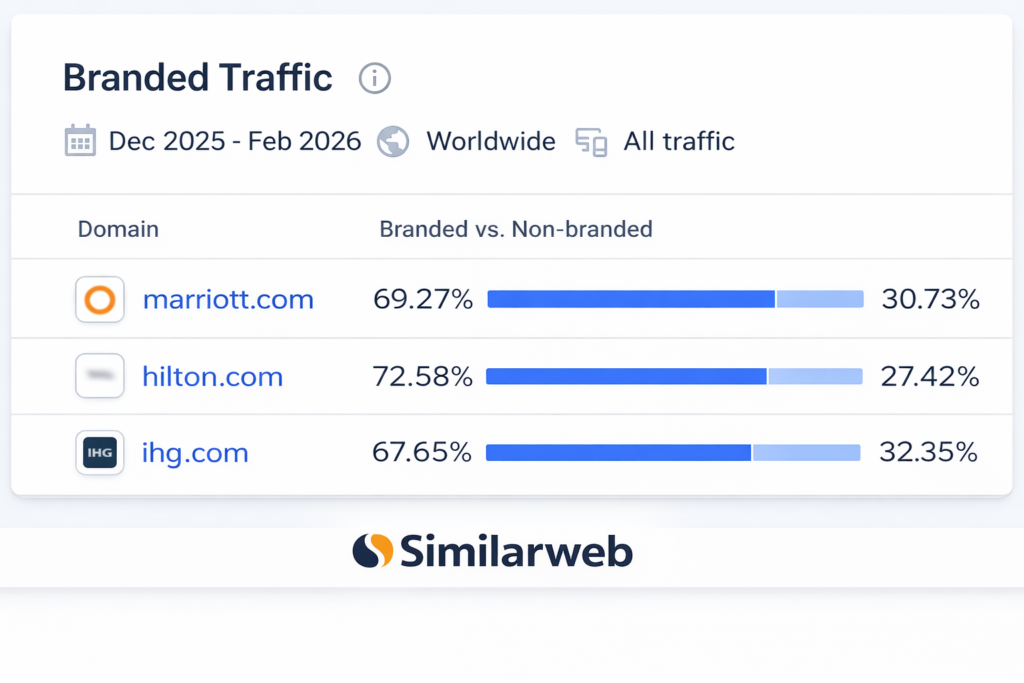
Yet:
- Most hotel websites generate 70–80% of organic traffic from branded keywords
Which means:
- Hotels are not participating in demand creation
- They are only capturing demand that already exists
This gap is not theoretical, it is measurable. And it is where OTAs and publishers continue to expand their lead.
Hotels have the opportunity to participate in this layer by building destination-driven content and capturing long-tail demand. In practice, very few do. This is where marketing should play a strategic role, but often remains underdeveloped.
Internal constraints slow down meaningful change
It is also important to acknowledge the operational reality inside most hotels.
Marketing teams are often small, resources are limited, and technology stacks are fragmented. More importantly, OTAs provide immediate and predictable revenue, which makes them difficult to deprioritize.
Even when leadership wants to increase direct bookings, shifting distribution strategy requires time, coordination, and sustained investment. This makes progress incremental rather than transformational.
What actually moves the needle over time
Hotels that gradually improve their direct booking share tend to focus less on short-term tactics and more on building foundational capabilities.
This typically includes:
- Developing niche demand instead of competing broadly
- Investing in website performance and booking experience
- Building consistent brand presence across channels
- Capturing and activating first-party customer data
These efforts do not deliver instant results, but they create compounding advantages over time.
The structural imbalance is clear
If you put the data together, the pattern is consistent:
- OTAs control discovery (SEO + paid)
- OTAs convert better (UX + trust + scale)
- OTAs retain users (data + ecosystem)
Hotels, meanwhile:
- Operate with fragmented tools
- Rely on brand demand they often don’t have
- And try to compete channel-by-channel instead of system-wide
Final thought
The data doesn’t suggest that hotels are doing everything wrong. It suggests that they are playing within a system designed around platforms.
Direct booking is difficult not because it is misunderstood, but because it requires capabilities that most hotels have not historically built.
Direct booking is not limited by tactics. It is limited by how much of the demand, data, and customer relationship a hotel actually owns, and the data clearly shows that today, most of it still sits with OTAs.
From the Author
Thanks for reading Hospitality Insider ☺️

This site is basically where I try to make sense of hospitality marketing while working inside the industry. I’m not an expert, just someone curious enough to observe, analyze, and write things down.
If you have thoughts, different perspectives, or just want to talk about hospitality marketing, feel free to connect with me on LinkedIn.
Vee Nguyen
Founder, Hospitality Insider
If you enjoyed this article, a quick like would mean a lot 💙
Latest Insights
Observations and analysis on hospitality marketing, distribution, and growth.

Why Most Hotel Blogs Fail (Even When They’re Active)
May 10, 2026Publishing more content won’t fix your traffic. Here’s why most hotel blogs fail and how to align content with real search demand.
What Hotel Content Actually Drives Organic Traffic?
April 19, 2026This is why many hotels feel like they are “doing content” but seeing no results.

Can Hotels Really Generate Demand Without OTAs?
April 5, 2026Everyone talks about reducing OTA dependency, but from what I’ve seen, a lot of hotels aren’t even in a position to do that yet